Yearly Archives: 2013

Michele Bachmann Will Not Run For Re-Election (Updated)

Michele Bachmann is currently serving her last term and will not seek re-election.

She claims to have suddenly grown the opinion that there should be term limits on Representatives in the House, but that is not very likely the reason. It could be that she is behind in the polls, and it could have something to do with the impending criminal and ethics investigations. If it the latter, perhaps we should be expecting some news in the near future regarding these investigations.

Either way,

Maybe she plans to run for Senator against Al Franken?

OH please, please, please, let it be so!

UPDATE: Here’s Michele Bachmann’s YouTub video explaining how wonderful she is and stating that she WILL run for public office if she decides it is necessary for her to save the United States of America from itself. She also states that it is necessary for her to save the United States of America from itself, so do indeed expect her to run:

Secular Woman Statement on Ron Lindsay’s WIS-2 Comments

Secular Woman is an organization I’m proud to be a member of. SW has released a statement responding to the latest dust up in the Secular-Atheist-Skeptical Community in which CFI leader Ron Lindsay somehow got assigned the job of giving the welcoming/opening talk to the second Women in Secularism Conference, and made a big mess of it.

Here’s the first part of the statement, click through to read the rest:

The Secular Woman Board of Directors, in consultation with our most active members and supporters, regrets having to express our organization’s deep concern over recent public statements from Dr. Ron Lindsay, Center for Inquiry (CFI) CEO, during and following that organization’s Women in Secularism (WiS) conference this past weekend.

Secular Woman promoted the WiS event heavily with our membership for months. During this period we raised $2190 that enabled seven women, relatively new to the secular movement, to experience an event they would not otherwise have had the means to attend. Based on member feedback, we estimate that another 25 of the reported 300 WiS attendees were at the conference because of Secular Woman’s encouragement. Additionally, 57% of our Board of Directors was present.

Through Secular Woman’s @AbortTheocracy campaign, thousands of our fans, followers and members have been made aware of CFI’s efforts in the area of reproductive rights. In fact, CFI is the only organization to have taken advantage of this service announced to secular leaders on an internal list-serv for leaders in the secular movement.

Given our support and the aims of WiS, we find it stunningly unacceptable that Dr. Lindsay chose to greet our members, our Board, and other attendees with his personal, ill-formed criticisms of feminism rather than welcoming us all to the conference we had promoted and paid to attend. Worse, he instead chose to personally welcome a man who has harassed and antagonized many of the speakers scheduled for the weekend, and who now has an interview about the conference on the front page of the website of A Voice for Men, which is monitored by the Southern Poverty Law Center for their misogynistic content.

We are incredulous that in a conference about women in the secular movement Dr. Lindsay was completely silent about the threats, harassment, and stalking that many atheist women have experienced at the hands of other atheists. Additionally, we are truly appalled by the tone and content of his blog post, “Watson’s World and Two Models of Communication,” in which he bizarrely compares Rebecca Watson’s writings to missives from North Korea, misuses a Secular Woman statement to his own purposes, and claims that those who are active feminists cannot be real reason-and-evidence based secularists.

Not having seen an apology, retraction, or other followup to these official communications, we are forced to arrive at several conclusions:

Click Through.

Cosmic Bombardment of the Earth ca 2.2 Million Years Ago?

There are bacteria that use Iron (and other elements) to make tiny magnets that they carry around so they don’t get lost. (I anthropomorphize slightly.) There are isotopes of Iron that are not of the Earth, but are found only elsewhere in the universe.

Suppose an event happened elsewhere and spewed some of that cosmic Iron isotope, say Fe-60, onto the earth, and the bacteria who were busy making their tiny compasses at that time used some of it. Then the bacteria died and were trapped inlayers in seafloor sediment and later examined by scientists looking for … well, looking for evidence of cosmic events trapped in bacterial compasses!

Well, that happened.

A bit of sea floor was found to have Iron-60 in it a few years back. Iron-60 is radioactive and decays into Cobalt-60, with a known (but only recently known as it turns out) decay rate. That bit of rock was taken as possible evidence of an ancient supernova. The event was tied, conjecturally, to human evolution as all things must be whenever even remotely possible:

Cosmic fallout from an exploding star dusted the Earth about 2.8 million years ago, and may have triggered a change in climate that affected the course of human evolution. The evidence comes from an unusual form of iron that was blasted through space by a supernova before eventually settling into the rocky crust beneath the Pacific Ocean.

The team has now analysed a … piece of ocean crust, where the supernova detritus is concentrated into a clear band of rock that can be accurately dated. The researchers found small but significant amounts of an isotope called iron-60 in the rock, which could only have come from a supernova.

“We’ve looked at all the possibilities and we can’t find anything else that could produce such quantities,” Korschinek says.

The human evolution impact idea comes from a possible cooling effect the exploding star would have had on the earth. Back in 2004 it was estimated that the earth would have been bathed in extra cosmic rays for about 100,000 years which would have, it was said, created condensation in the atmosphere which would have cooled the earth. There was a cooling event around that time (but quite possibly well after this date, so don’t hang any hats on this) so I suppose this could be. But, I’m not going to assume that the cooling effects of cosmic rays are a thing at this point. I do know that people have gotten the effects of upper level vapor wrong a few times so I’m going to avoid making any assumptions about that here.

Anyway, last April, a paper was given at the American Physical Society conference giving preliminary findings related to some follow up research. Shawn Bishop and his team obtained a core from the Pacific dating to between 1.7 and 3. 3 million years ago. They sampled it at 100K intervals and extracted and separated out Iron in a way that would show Iron-60 if there was any. And …

“It looks like there’s something there,” Bishop told reporters at the Denver meeting. The levels of iron-60 are minuscule, but the only place they seem to appear is in layers dated to around 2.2 million years ago.

And, the iron was concentrated in the target layers by the action of compass-using bacteria.

Notice the change in date from 2.8 to 2.2. This is, I think, because the half life of Iron-60 was refigured based on some intervening research. Now, the date is probably too late for a significant cooling event. But really, there were a whole bunch of cooling events from somewhere over 5 million years ago to about 2 point something million years ago, and there is a long list of candidates for what caused them, including numerous big volcanoes, continental movements, and now, a supernova.

I don’t think anyone is claiming to know what star exploded.


Photo Credit for picture of fancy science machine: Gottfried not Bouillon via Compfight cc

The Need for Health and Biomedical Science Education Programs Aimed at Grades K–12 at the National Institutes of Health (NIH)

Recent reconfiguration of federal funding for STEM education has resulted in important programs at the NIH losing their funding. Below is information on Health and Biomedical Science Education Programs Aimed at
Grades K–12 at the National Institutes of Health (NIH).


In the proposed FY 2014 budget, President Obama has set a policy that all STEM education funding be consolidated into three institutions, the NSF for graduate and undergraduate training, the Dept. of Education for K-12 STEM and the Smithsonian for informal education. Justification for this policy was improved efficiency and reduction of duplication of efforts, despite the government’s Committee on STEM Education (CoSTEM) Dec. 2011 report, Federal science, technology, engineering, and mathematics (stem) education portfolio, conclusion that “examination of the inventory data indicates very little overlap and no duplication among Federal STEM education investments.”

This policy is problematic because it dictates that NIH cease all STEM education programs, which includes the Science Educator Partnership Awards (SEPA) that fund BrainU (that is a specific program that is losing its funding). NASA and NOAA have also been prevented from continuing their STEM education efforts. These agencies have already begun policy implementation as Executive branch employees execute presidential policy. All NIH health education programs will disappear officially Oct. 1, 2013 unless we mobilize Congressional action to reinstate funding for SEPA. A full description of this problem can be found at http://nwabr.wordpress.com/2013/05/01/nih-science-education-programs-at-risk/.

This is problematic because a sub-mission of the NIH is to disseminate health information. This policy decision means that NIH will lose the ability to share health science educational materials for K-12 audiences. For scientists like myself who translate health information knowledge directly to teachers and indirectly to their students, this is a major setback. This policy sends the message that my colleagues and I are not supposed to be communicating with you as teachers.

Here’s what you need to do to raise your voice in support of SEPA

Contact your US Congressional Representatives and Senators. Below is a draft letter being circulated to all SEPA programs and participants, but you may find this letter a good template for making a more generalized show of support even if you are not a SEPA person. It only takes a few minutes to personalize this letter (1- 2 sentences is enough) and paste it into the contact your congress websites (see below). This is especially important for those of you in the south Metro and near SE MN who live in Minnesota’s 2nd District – U.S. Congressman John Kline’s district – as he is chairman of the House Education and Workforce Committee.

Our “ask” in these letters is that the funding for NIH health science K-12 education programs (SEPA) be reinstated.

We view neuroscience as part of health education since our message has been – and continues to be – that teaching learners about how their brains change through learning will improve their prospects and motivation to learn in all formal education settings AND in life as they move forward.

Please go to the websites for your congressional representatives and upload this letter with your personal touches to this campaign to save the NIH Science Education Partnership Award (SEPA) program from which BrainU is funded.


More Information:

Health and biomedical sciences for grades K-12 are critical components of STEM education that help to ensure the nation’s capability to prevent disease and improve health. The proposed 2014 STEM education consolidation plan, however, eliminates K-12 health and biomedical science education from its traditional place in the portfolio of the National Institutes of Health (NIH), and, by default, from the national STEM education agenda. No other federal agency supports programs comparable to those that would be lost.

More than 65 NIH-funded, K-12 health and biomedical science education projects currently operate in 40 states. These include “in-person” programs for more than 82,500 K-12 students and 5,750 K-12 teachers each year, and online programs that reach more than 20 million K-12 students and educators annually. NIH-funded exhibitions at some of the nation’s largest museums and science centers reach millions more students, teachers and families. With emphasis on engaging underserved populations, K-12 educational initiatives supported by NIH create thoroughly evaluated, science-rich interactive exhibits, curriculum materials, teacher professional development programs, student and teacher research experiences, and out-of-school learning opportunities.

Ongoing NIH-funded K-12 educational programs benefit the nation in the following ways.

<ul>
  • Improve preparation for, and access to careers in medicine, healthcare, biotechnology and biomedical research, with a focus on students from under-represented groups.
  • Address health disparities by increasing access to college and health professions careers for under-served students, who are more likely than their peers to practice in medically underserved areas.
  • Build public understanding and support of biomedical research and clinical trials through educational programs that emphasize the relationship between NIH discoveries and their translation into positive health outcomes
  • Encourage and facilitate involvement of biomedical research scientists in K-12 STEM education, and engage the resources of colleges, universities, medical schools and science museums in supporting K-12 STEM education.
  • Promote health literacy and better decision-making to address preventable health problems among America’s youth, reduce the burdens of chronic illnesses and infectious diseases, and enable consumers to make sense of genetic and other newly available health information.
  • Increase students’ interest in STEM topics through personally relevant examples from health and biomedicine that are aligned with recommendations of the Next Generation Science Standards.
  • For more than two decades, NIH has invested in the development of human capital and a unique infrastructure that is meeting our nation’s K-12 health and biomedical science education needs. These investments have produced significant, demonstrable outcomes that would not have been possible otherwise. Current K-12 programs sponsored by NIH, including the Office of Science Education, employ rigorous, results-oriented and cost-effective approaches to tackle major national issues, as listed below.

    Jobs: Healthcare and biomedical science are crucial elements of the economy. The US Department of Commerce estimates that healthcare accounts for $1.75 trillion in revenues and employs more than 14 million people (nine percent of the US workforce).

    Provider Shortages: The nation faces an acute shortage of healthcare workers in all areas, and the problem is expected to grow. The American Association of Medical Colleges projects that there will be a shortage of more than 90,000 physicians—including 45,000 primary care physicians—by the end of the decade. About 55 million people already lack access to a physician.

    Wellness and Disease Prevention: According to the Milken Institute, more than half of all Americans suffer from one or more chronic diseases, many of which are preventable. Healthcare spending is projected to reach almost 20% of the US gross domestic product by 2021. Racial and ethnic minorities suffer disproportionately from diseases such as cancer, diabetes and HIV/AIDS, but participate less frequently in programs that could help to reduce disparities.

    Without K-12 health and biomedical science education initiatives, our nation will be unable to solve many of its most pressing workforce, economic and healthcare problems.


    Draft Letter

    May 22, 2013

    The Honorable

    Dear :

    I write to express my deep concern that the President’s proposed “consolidation” of Science, Technology, Engineering and Mathematics (STEM) education programs will eliminate the health-centered, precollege (K-12) education programs of the National Institutes of Health (NIH). For more than two decades, these programs have been the primary method by which NIH translates its basic and clinical discoveries to millions of children, families and teachers in the US.

    As your constituent, I urge you to consider the implications of this change and to support retention of funding for K-12 health-related education within NIH, enabling the Institutes to continue this broad, critically important pathway to health literacy and jobs.

    The programs slated for elimination have been a tremendous resource for K-12 students and teachers, especially those in minority and disadvantaged schools, for whom biomedical educational resources are very limited. Equally important, they are unique among all federal programs in enhancing health literacy and are crucial to NIH’s mission of promoting the health of our nation’s citizens. “In-person” programs engage more than 82,500 K-12 students and 5,750 K-12 teachers each year and online programs reach more than 20 million annually. Exhibitions at some of the nation’s largest museums and science centers reach millions more children, teachers and families

    None of the agencies delegated to assume responsibility for STEM programs – National Science Foundation, Smithsonian Institution, and Department of Education – have a health education priority. The proposed action will result in the loss of critical, high-impact health-focused programs. Consolidation will greatly reduce the number of students entering health and biomedical research careers, threatening our nation’s overall health and health literacy.

    NIH precollege programs enable biomedical researchers, health professionals and educators at universities, colleges, science museums and other organizations to connect with teachers, children and their families across the country. This outreach provides our communities with invaluable learning opportunities related to research, health, and wellness. Biomedical and health sciences are important areas of workforce development for the US economy in the 21st Century. Research demonstrates that NIH K-12 education programs are key to attracting students to these fields, thereby driving a robust biomedical economy and enhancing national health and wellness.

    As a participant in the NIH SEPA BrainU program at the University of Minnesota, . Understanding how brains learn and process information is critical health information that learners will use throughout their lives. This message is one from the 80+ programs that will be abruptly ended by the consolidation policy that does not distinguish health literacy from general STEM education.

    These essential programs must be retained so that the NIH can meet its unique mission of fostering our nation’s leadership in biomedical discovery and improving the health of its citizens. If this consolidation occurs, these effective programs and expertise will be lost.

    Please feel free to contact me about this issue. I would be glad to provide additional insights into how this program has impacted my classroom so we may work together to save these important NIH programs.

    Sincerely,

    your name

    Question for my readers.

    Don’t make a move until you’ve CLICKED HERE.

    Then you can continue on to this post. Thanks.


    I think the accusation that I’ve “stalked” fellow blogger Abbie Smith have been made one too many times. But I’m not sure. Is this the point where I lay out the exact sequence of events of what happened between us? What do you think?

    OK, here’s the story.

    Abbie Smith had created an informal group of people who were to eventually become known as the Slyme Pit, mostly Mens Rights Activists, who had come together to object to feminist writings by various bloggers and others, especially those writings that criticized rape and abuse, stalking and harassment, etc. The Slyme Pitters are mostly techies or self styled skeptics, mostly males, who had been enjoying their sexist cultures and apparently did not like others speaking of alternatives to the basic patriarchic pattern. She created this community on her blog, on two or three blog posts here at scienceblogs, which were removed.

    Meanwhile she started up serious on line harassment campaigns against at least one graduate student, IIRC an undergraduate student, and a couple of senior academics. It was pretty nasty.

    So, as a member of the academic community I took it upon myself to write a polite letter to the chair of her department, where she was working towards a gradate degree. In this letter I, I informed him of the outline of the situation and suggested he might advice his graduate student to tone it down. This is something that happens now and then. Senior people sometimes have conversations about junior people when the junior people are outrageously out of line and victimizing their peers or those that they may even be senior to (the undergraduate/recent graduate, for example).

    I wrote the note to her chair and not her advisor because I did not know what kind of relationship she might have with her advisor. It is quite possible for grad student to have access to the advisor’s email, for example, depending on how they are employed. Also, I was concerned that Abbie might be as manipulative in her academic position as she was on her blog; for all I knew her advisor was one of the slymepitters. So I figured I’d step back one level and write it to her department chair. That is one of the few important jobs department chairs do: deal with problem graduate students. I also cc’d the dean/president’s office (can’t remember, anyway the head of the school Abbie was in).

    Within about 48 hours of me emailing this, I received an email from an on line person known as Gunter. Gunter is one of the slymepitters. He offered me a deal. I would apologize to Abbie for sending this note to her advisor (to whom I sent the note was already being gotten wrong) or he would publicize the email. You might wonder how some guy with no association whatsoever with Abbie’s department got a copy of an email I sent to the chair and head of the college.

    Wondering about that, I sent a second email, this time just to the head of the college and the council, asking if it was their practice to distribute emails concerning their students to members of the public, or was this something, perhaps, that the chair of Abbie’d department had done.

    I got a very contrite note back from the college. Abbie shut up, herself, thereafter. But members of the slyme pit, which has just recruited a new member or two, continue to turn this series of events … what I just described to you … into an accusation that I’ve stalked/harassed/whatever Abbie Smith.

    So, that’s what happened.

    Who are the Illuminati?

    From Wikipedia:

    “Illuminati” refers to various organizations … links to the original Bavarian Illuminati or similar secret societies, and often … conspire to control world affairs by masterminding events and planting agents in government and corporations to establish a New World Order and gain further political power and influence. … the Illuminati … lurk… in the shadows and pull… the strings and levers of power in dozens of …

    They are well documented in this book.

    And now, there is incontrovertible evidence of involvement of Hollywood and music industry stars in the Illuminati. Check it out: Continue reading Who are the Illuminati?

    How can I get rid of foot fungus?

    You can’t!

    There’s a fungus among us—a hundred different species in fact—and nearly all take up residence on our feet, according to a study that appears in the journal Nature this week.

    Only a few fungi species were found on other body parts known to house fungi—such as behind the ears and on palms—according to the most thorough analysis to date of our fungal “landscape.”

    Ha. You’re probably better off leaving most of them alone. Click through for the details.


    Other posts of interest:

    Also of interest: In Search of Sungudogo: A novel of adventure and mystery, which is also an alternative history of the Skeptics Movement.

    Do mites really live on my face?

    This is the question everyone eventually asks themselves. The answer is no. They live all over your body in the follicles of your hair.

    But, the situation is much more complicated than that, and in fact there is a lot we don’t know about these mites. But, there is a scientist who may be willing to scrape some of the mites off your face in order to advance our knowledge … of something many people would probably not really want to know about.

    We’re interested in studying the evolution and diversification of Demodex mites …we want to use the information encoded in Demodex DNA to map the mites’ “family tree” and see how closely that tracks our own human family tree.

    Our first task was to physically collect the critters … Although previous research (based on human cadavers) suggests that all adults have them, most researchers have only been able to collect mites off of 15% of the people they sampled when gently expressing sebum from pores (much like what an aesthetician does during a facial).

    Sure enough – after sampling 223 volunteers during public events …

    Read the rest here, and see pictures of the mites and people getting their faces … sampled!

    LA State Government and Jindal Rip UP US Constitution

    … To protect gun owners by repressing journalists.

    On Tuesday, the Louisiana Senate passed a bill that would imprison and fine journalists who intentionally publish information about the state’s concealed-carry handgun permit holders. Reporters who violate the law would face penalties of up to $10,000, six months in jail, or both; public safety officials and police officers who leak permit information to the press would face penalties of up to $500, six months in jail, or both. Journalists in Louisiana say the bill is clearly unconstitutional, but that won’t stop it from becoming law: After the Senate vote, it headed to Gov. Bobby Jindal’s desk for his signature.

    MJ has the details on why this is bad.

    The thing is, I know this blatant oppression of the Constitutional Rights Rights of Americans can’t happen becase the 2nd amendment allows us to protect ourselves from an oppressive government. I assume the members of the Press in Louisiana will all now by guns so when Jindal’s black booted storm troopering thugs come to get them, the Journalists can defend themselves.

    Worst Person In The World: Emma Way of the UK

    Emma Way (formerly @EmmaWay20, but she has deleted her account) was driving down the road and turned into oncoming bike riders who were in a race. She hit one of them, knocking him into the woods. He’s OK.

    She tweeted abut how proud she is of having done that, making the claim that this was OK because bikers don’t have the right of way and don’t pay road taxes.

    The police picked up on her tweet and tweeted her a suggestion that she report the incident and DM them back. Others picked up on her tweet and scanned her social networking streams and found all sorts of other horrid things. Apparently she was into doing selfies of herself (obviously) tailgating other vehicles and driving at excessive speeds.

    Emma Way is a horrible, terrible, awful person. Is she redeemable? I don’t know. Maybe you found this blog post because you are googling her and she’s a job applicant. If you hire her and find out that she’s reformed, post a comment and let everyone know!

    (And she will be looking for a job. Her current employer appears to be poised to fire her.)

    The UK does not have a road tax.

    Understanding Storms and Global Warming: A Quaint Parable

    A quaint New England rocky creek

    Imagine standing next to Parable Creek, an imaginary rocky brook in New England. The water is rushing past you from left to right, around the rocks that emerge tall above the surface of the stream, mounding over the top of those that are lower down. The deepest parts of the steam are relatively flat but show ripples that belie the presence of other rocks and sunken branches that are well below the water line.

    While you are observing a young boy of about 11 years old comes along, carrying his fishing pole. “Hey mister, how’s it going?” he says, as he steps into the stream. “I’m going fishing over there,” he says pointing in the direction of a mill pond a mile or so away. As he crosses the stream you notice that whenever he puts is foot down, some of the water mounds up on the upstream side as it rushes by him. He continues across the stream and climbs the opposite bank, running off to his destination. You wish him good luck with his fishing and return to your observations.

    You can see large eddies here and there that seem to persist though they may change shape or grow or shrink a little. Smaller eddies, mini vortexes, form in certain parts of the stream, and rush down slope only to disappear as the water crashed into an obstruction. Every here and there there is a splash caused by the rushing water hitting a rock or branch just the right way.

    Now, imagine that you are a compulsive data collecting scientist standing next to the rocky brook with nothing else to do for a while. So you start measuring things. Every where you see a mound of water built up in the current alongside a rock, that is a bit of kinetic energy (water moving) converted momentarily in to potential energy (water rising against gravity). So you estimate the number of mounds and their collective mass. This is a measurement of one form of energy in the stream.

    You make a prediction. If the amount of water coming down this stream increases for a while, the total energy of the stream will increase, and this will be visible as an increase in total potential energy in the mounds you’ve been measuring.

    Coincidentally it has been raining heavily upstream and just as you have formulated your hypothesis you see the water rising. Aha! A chance to test your prediction. At first, your hypothesis seems supported. As the water rises, the relative height of the mounds increases, and some new mounds form. You take some quick measurements, by eye, and note that the total potential energy stored in water mounds has increased, presumably as an effect of more overall energy in the stream. You gain confidence in your theory and congratulate yourself on your brilliance.

    But then, as the water level continues to rise something different happens. More and more of the stream is now above the obstructing rocks. Therefore, there is less conversion of kinetic to potential energy. Most of the mounds disappear and the overall surface of the stream is much smoother. You take a new set of measurements and estimate that the total potential energy stored in water formed into mounds is an order of magnitude LOWER than your original measurement. Apparently, you think, something is wrong with this stream.

    Just then a troop of Brownies comes along. The little girls want to cross the stream to take a short cut to their picnic grounds. They ask, “Hey, Mister, do you think it is safe to cross this stream?”

    You had a nice theory linking total energy and a specific observation, which seemed to be confirmed by some of your research. The total energy of stream flow is linked to the total mound-i-ness of the stream’s surface. Now, the stream’s surface is smoother than it was before. Therefore, the total energy of the stream is at the low end of its known variation. A while back you saw a small boy cross the stream with no problem. Clearly, it is safe to cross now.

    So, you say, “Actually, I’m sure it is quite safe. Go ahead and cross, and have a nice day!”

    The brownies jump happily into the stream and start wade through the water. Half way across the stream, one by one but over just a few seconds of time of time, they are carried away by the water and drown.

    “Hmmmm,” you think. “Maybe I had that wrong.”

    Rivers Of Air

    Air flowing over the surface of the land is a bit like water running down a stream or river. The air interacts with the ground (especially things like mountains). There are different layers, mounds, streams, and eddies of air that interact with each other. The overall form of movement is shaped by the spin of the earth, the tendency of warm air to form in certain areas (i.e., near the equator, or over water during winter and over land during summer, etc.) which causes the air to pile up and spill into nearby eddies. There are all sorts of ways in which batches of air interact, and when you thrown in differential amounts of moisture in different air masses, and things like night vs. day, and so on, you get the surface of Parable Creek. Metaphorically. In real life, we call the The Weather.

    When the total energy in the system of air movement changes the way those crazy zany air masses move and what sorts of weather form can also change. For example, there is in total more energy on the hemisphere (north vs south) that is sticking its face towards the sun. It seems that one result of this is that the hemisphere with more energy (the summer end of the earth, as it were) has hurricanes, severe thunder storms, tornadoes, and so on while the hemisphere with less energy has less of that stuff.

    However, a tornado is like a small eddy in the stream, and a hurricane like a large eddy, and a line of thunderstorms like the outer edge of one the mounds and the rainstorms are like the splashes at the edge of the log and so on and so forth. As Parable Creek’s level rises, exactly which phenomena are predominant changes, even as the total ability of the stream to wash away Brownies increases to the level where it can also wash away Girl Scouts and eventually Brawny Construction Workers and Bikers. Having said that, while a rocky stream converts to a large and deep river by adding a LOT of water, which may have a smooth surface despite the total energy of the river being orders of magnitude greater than Parable Creek’s energy, the system of air movement is not likely to become smoother owing to various limitations in the system.

    Too Much Variability

    You can’t measure the energy in the stream by only looking at one of the many phenomena that are the manifestations of that energy. In order to understand the relationship between global warming and storminess, it is minimally necessary to measure all of the storminess and find some way to combine it.

    I remember when I first moved to Minnesota. That summer we had numerous straight line wind events of the sort never seen before. Maplewood, a community near where I lived famous for it’s tree lined streets lost almost all of its trees in one storm. That same storm also took out most of the stock of most of the new car companies in that town, famous for its numerous car lots. The cars were pitted with hail stones. Every single home for about three miles along a street right near where I lived had it’s vinyl or aluminum siding drilled with hundreds of holes and dents from large hail stones being driven by a 60–100 mile per hour wind. It was one of the worst weather years in Minnesota, with insurance companies practically going bankrupt.

    There were only a few tornadoes in the area that year.

    The next year there were hardly any straight line wind storms of the magnitude just described. But that is the year of the Saint Peter tornado. It was one of the largest tornado events ever; It was a twister that lifted and dropped a couple of times, so ‘nato-pedants divide it into multiple events, but that’s absurd. It was an F3 and F4 event, and it tracked for 67 miles and was up to one and a half mile wide.

    There were a lot of tornadoes that year.

    The atmosphere over central and southern Minnesota had a lot of energy those two years, for whatever reason. If we want to understand the total energy, and its effects on life and property, we would be doing a disservice to our pursuit of understanding if we failed to consider both straight line winds and tornadoes together (though obviously also separately).

    The Big Picture

    Weather comes in bands. The biggest and most obvious band is the Intertropical Convergence Zone, a band of thunderstorms that rings the entire planet and is pretty much always active. Another band is the arid band that rings the earth; actually there are two of them, one in the Northern Hemisphere and one in the Southern Hemisphere. Almost every major desert on the earth is in one of those bands. In fact, any desert that is not in one of those bands has to explain itself, and the excuse is usually a mountain rain shadow. Conversely, any wettish areas in those bands also have some ‘splainin to do. The southeastern US is in the Northern Hemisphere’s arid band, but the Gulf of Mexico keeps that region pretty wet much of the year.

    Severe weather is also patterned in these bands, to some extent. Hurricanes form in the bands just north or south of the Intertropical Convergence Zone. Tornadoes tend to be confined to subtropical and southern temperate bands away from the equator. In a sense, one could say that most tornadoes that are not spinoffs from hurricanes occur in a certain band either north or south of the equator, and if we are going to count tornado activity, measure its total intensity, etc., we should be looking more globally at those zones, not just parts of those zones.

    This of course applies to national borders as well. Tornadoes occur in the US but also in Canada, but the most easily available tornado data for North America is always presented as US tornadoes. Also, years are tricky. Events that span Jan 1st are hard to track if we count things by calendar years.

    Some have been harping about the “tornado drought of 2012” as evidence that there is not an increase in tornadoes owing to global warming. Well, there are very few US tornadoes in January, but the January with the most tornadoes ever (in our records) was January 2012. Also, Canada had a lot of tornadoes in 2012. Has anyone looked to see what the combined US and Canadian count would be? And, how do you count a Canadian Tornado? The very fact that a tornado forms 1000 miles north from where most occur has something to do with the nature and distribution of atmospheric energy across the plant’s surface. I’m not making a specific claim about the distribution of tornadoes across time and space. I am saying, rather, that counting tornadoes within an arbitrary boundary in space (or time) can be misleading.

    Then, there is the problem we have with all of these storm types, especially tornadoes and hurricanes, of how to actually measure them. Even using standard severity scales, tornadoes can be very different from each other in ways that are not counted in the usual statistics. An F3 tornado that is extra wide and stays on the ground for 100 miles involved significantly more energy than an F4 that formed momentarily and disappeared. Indeed, the different kinds of tornadoes (funnel vs. wedge, for example) really may be very different (but closely related) weather phenomena that should be examined separately at the very same time we combine vastly different storm types to measure and understand at a larger, global scale.

    Tornadoes are not a good canary, in the canary in a coal mine sense. But they are obviously important. When we see people stating clearly and plainly that we need not be concerned about the frequency of tornadoes increasing with global warming, we should ask why they are saying that. We should be concerned with increasing storminess … there is almost no way that is not going to happen, and likely, it already has. If tornadoes are part of that increase storminess, we may want to get smart about it fast. For instance, we might want to take seriously the problem of schools and workplaces, where people tend to concentrate, having actual storm shelters instead of just hallways that some administrators says is a storm shelter, for protection when a big tornado comes along. Don’t you think?

    See also this post which more directly addresses the question of tornadoes and global warming.

    Photo Credit: Hamed Saber via Compfight cc

    Are there more tornadoes because of global warming?

    There are good reasons to believe that global warming leads to more storminess, but the exact nature of that transition is unclear and hard to measure. Part of the reason for this difficulty is that a given type of storm may become more likely under certain conditions caused by climate change, while a different kind of storm may become less likely, with the “storminess” overall increasing but doing so indifferent ways across time. Also, the most severe, and thus possibly the most important, weather events are infrequent so it is difficult to see changes over time with any statistical confidence. I address many of these issues here and here.

    Looking at the raw data, it is clear that there are “more tornadoes” over time in the US. Have a look at this graph:

    Annual number of tornadoes for the period 1916-1995; the dashed line connecting solid circles shows the raw data, the red heavy solid line is the result of smoothing. Also shown in the green light solid line is the number of tornado days (i.e., days with one or more tornadoes) per year.
    Annual number of tornadoes for the period 1916-1995; the dashed line connecting solid circles shows the raw data, the red heavy solid line is the result of smoothing. Also shown in the green light solid line is the number of tornado days (i.e., days with one or more tornadoes) per year.

    At first glance, his graph makes it look like there are a lot more tornadoes, but there is a strong effect of observer error; earlier tornadoes were simply missed much of the time, so the big increase you see here, while it may reflect an underlying increase in number of tornadoes, is not reliable and cant’ be taken as evidence. However the later years shown here, from 1950-something to the 1990s, seems to show an increase that could be taken as meaningfull

    However, when people speak of tornadoes they often show this graph as evidence that there are not more of them over time:

    Looks like the number of tornadoes does not go up over time.
    Looks like the number of tornadoes does not go up over time.

    Looking only at this graph it looks like the number of tornadoes per year in the US is pretty variable but not increasing, as one would expect if global warming was causing more of them.

    There is a problem with this graph, however. Actually, a couple of problems (other than those pointed out here). The main problem is that the most frequent tornadoes are left off this graph. If we look at F0 grade tornadoes, not included here, we see that they have actually increased in frequency over time. If we include ALL tornadoes, and not just the kinds that don’t seem to increase in frequency over time, we get this graph:

    Huh.  Maybe the number of tornadoes DOES increase over time!
    Huh. Maybe the number of tornadoes DOES increase over time!

    Compare the scales of the last two graphs. It turns out that the number of tornadoes at the smaller end of the scale goes up quite a bit. It might be hard to see. The upper graph goes up to 900, the lower graph goes up to 1900. So, if we add all the data instead of just select data, we get many hundreds more tornadoes per year.

    The proportion of tornadoes that are F0 increases over time as shown here:

    Tornadoes_Ratio_of_F0-RatioofEF0s

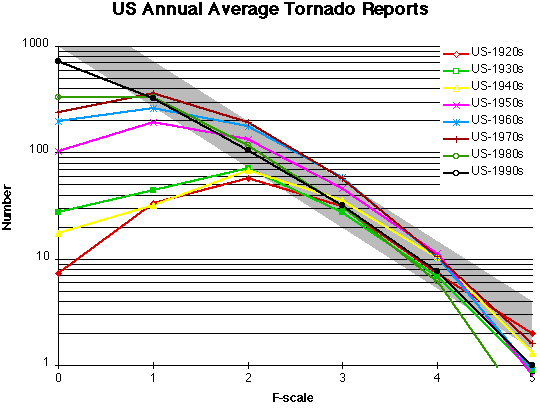
    … and the overall distribution of tornadoes by strength changes over time as shown in this very cool graph:

    It isn't just the F0 tornadoes changing over time.  The overall pattern of tornadoes shifts with time.
    It isn’t just the F0 tornadoes changing over time. The overall pattern of tornadoes shifts with time.

    As I point out here, one of the contributing factors to variation over time in tornado frequency is the fact that we have somewhat arbitrary boundaries in which we measure them. For instance, the US-Canada border provides an arbitrary line across our data set. By not counting all North American tornadoes the same way, we may be adding unnecessary variability to the data. To demonstrate this, have a look at this graph showing tornado frequency per year in France and Germany, two countries that are right next to each other:

    Frequency of tornadoes in France and Germany ... seems to be uncorrelated.
    Frequency of tornadoes in France and Germany … seems to be uncorrelated.

    This shows a few things. For one thing, they don’t have too many tornadoes in that part of the world. For another thing, there is an increase in overall frequency over time, and this is not because of lack of reporting. The reporting problem in the US is partly because the western and central states were relatively empty in the old days, and also more technology was available for spotting tornadoes later. But the European and US data have the same shape over a similar time span, but France and Germany do not have the missing observations owing to vast unoccupied (sort of) territories.

    But the main thing I want to demonstrate with this graph is the fact that dividing a largish area of land up into arbitrary units can cause your data go go all flooey. Increased variability in data owing to partitioning is a well known phenomenon and this is what it looks like.

    Another part of the problem is that the largest storms, which may be the most important ones, have a great deal of variation in their occurrence. Compare any of the graphs above of all tornadoes or all excluding the F0 tornadoes of this graph of just the largest storms:

    Pay attention to the vertical scale, but note that there is a lot of variation over time in these large events.  This kind of data almost has too much variability to track change over time meaningfully
    Pay attention to the vertical scale, but note that there is a lot of variation over time in these large events. This kind of data almost has too much variability to track change over time meaningfully

    Not only is there a lot of variation in numbers of tornadoes at the larger end of the scale, but I suspect there is a lot of variability among the tornadoes in each class in terms of overall energy represented. An F4 tornado that lasts five minutes compared to an F4 tornado that lasts 20 minutes are hugely different, but this is not reflected in this sort of data.

    Here is a graph showing the amount of storm damagein adjusted dollars over time in the US (pink) with average temperature (blue). Clearly, the total amount of damage goes up, and probably for a number of reasons including there being more stuff to damage, but also, likely overall increases in storminess including hurricanes, tornadoes, severe thunderstorms, etc.

    More storm damage over time
    More storm damage over time

    Here is another graph that shows something similar:

    Increasing bad stuff over time.
    Increasing bad stuff over time.

    There are many who do not want to link increases in severe weather to global warming. They are probably wrong. Global warming seems to increase severe weather overall. The best way to deny this is to cherry pick the data by ignoring variability across space, leaving out entire categories of storms, or focusing on just some kinds of storms. I suspect the size and severity of tornadoes at the larger end is increasing now, but did not start increasing until recently; time will tell if this is right. But overall tornadoes are so variable across time and space that they are not a reliable canary, as it were. But overall storminess seems to be on the increase, in accordance with expectations from the basis physics of climate, under warming conditions.

    Photo Credit: Vvillamon via Compfight cc