Tag Archives: Climate Change

Are there more tornadoes because of global warming?

There are good reasons to believe that global warming leads to more storminess, but the exact nature of that transition is unclear and hard to measure. Part of the reason for this difficulty is that a given type of storm may become more likely under certain conditions caused by climate change, while a different kind of storm may become less likely, with the “storminess” overall increasing but doing so indifferent ways across time. Also, the most severe, and thus possibly the most important, weather events are infrequent so it is difficult to see changes over time with any statistical confidence. I address many of these issues here and here.

Looking at the raw data, it is clear that there are “more tornadoes” over time in the US. Have a look at this graph:

Annual number of tornadoes for the period 1916-1995; the dashed line connecting solid circles shows the raw data, the red heavy solid line is the result of smoothing. Also shown in the green light solid line is the number of tornado days (i.e., days with one or more tornadoes) per year.

At first glance, his graph makes it look like there are a lot more tornadoes, but there is a strong effect of observer error; earlier tornadoes were simply missed much of the time, so the big increase you see here, while it may reflect an underlying increase in number of tornadoes, is not reliable and cant’ be taken as evidence. However the later years shown here, from 1950-something to the 1990s, seems to show an increase that could be taken as meaningfull

However, when people speak of tornadoes they often show this graph as evidence that there are not more of them over time:

Looks like the number of tornadoes does not go up over time.

Looking only at this graph it looks like the number of tornadoes per year in the US is pretty variable but not increasing, as one would expect if global warming was causing more of them.

There is a problem with this graph, however. Actually, a couple of problems (other than those pointed out here). The main problem is that the most frequent tornadoes are left off this graph. If we look at F0 grade tornadoes, not included here, we see that they have actually increased in frequency over time. If we include ALL tornadoes, and not just the kinds that don’t seem to increase in frequency over time, we get this graph:

Huh.  Maybe the number of tornadoes DOES increase over time!
Huh. Maybe the number of tornadoes DOES increase over time!

Compare the scales of the last two graphs. It turns out that the number of tornadoes at the smaller end of the scale goes up quite a bit. It might be hard to see. The upper graph goes up to 900, the lower graph goes up to 1900. So, if we add all the data instead of just select data, we get many hundreds more tornadoes per year.

The proportion of tornadoes that are F0 increases over time as shown here:

Tornadoes_Ratio_of_F0-RatioofEF0s

… and the overall distribution of tornadoes by strength changes over time as shown in this very cool graph:

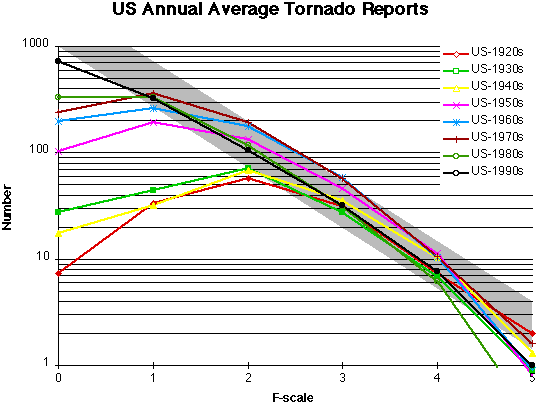
It isn't just the F0 tornadoes changing over time.  The overall pattern of tornadoes shifts with time.
It isn’t just the F0 tornadoes changing over time. The overall pattern of tornadoes shifts with time.

As I point out here, one of the contributing factors to variation over time in tornado frequency is the fact that we have somewhat arbitrary boundaries in which we measure them. For instance, the US-Canada border provides an arbitrary line across our data set. By not counting all North American tornadoes the same way, we may be adding unnecessary variability to the data. To demonstrate this, have a look at this graph showing tornado frequency per year in France and Germany, two countries that are right next to each other:

Frequency of tornadoes in France and Germany ... seems to be uncorrelated.
Frequency of tornadoes in France and Germany … seems to be uncorrelated.

This shows a few things. For one thing, they don’t have too many tornadoes in that part of the world. For another thing, there is an increase in overall frequency over time, and this is not because of lack of reporting. The reporting problem in the US is partly because the western and central states were relatively empty in the old days, and also more technology was available for spotting tornadoes later. But the European and US data have the same shape over a similar time span, but France and Germany do not have the missing observations owing to vast unoccupied (sort of) territories.

But the main thing I want to demonstrate with this graph is the fact that dividing a largish area of land up into arbitrary units can cause your data go go all flooey. Increased variability in data owing to partitioning is a well known phenomenon and this is what it looks like.

Another part of the problem is that the largest storms, which may be the most important ones, have a great deal of variation in their occurrence. Compare any of the graphs above of all tornadoes or all excluding the F0 tornadoes of this graph of just the largest storms:

Pay attention to the vertical scale, but note that there is a lot of variation over time in these large events.  This kind of data almost has too much variability to track change over time meaningfully
Pay attention to the vertical scale, but note that there is a lot of variation over time in these large events. This kind of data almost has too much variability to track change over time meaningfully

Not only is there a lot of variation in numbers of tornadoes at the larger end of the scale, but I suspect there is a lot of variability among the tornadoes in each class in terms of overall energy represented. An F4 tornado that lasts five minutes compared to an F4 tornado that lasts 20 minutes are hugely different, but this is not reflected in this sort of data.

Here is a graph showing the amount of storm damagein adjusted dollars over time in the US (pink) with average temperature (blue). Clearly, the total amount of damage goes up, and probably for a number of reasons including there being more stuff to damage, but also, likely overall increases in storminess including hurricanes, tornadoes, severe thunderstorms, etc.

More storm damage over time

Here is another graph that shows something similar:

Increasing bad stuff over time.

There are many who do not want to link increases in severe weather to global warming. They are probably wrong. Global warming seems to increase severe weather overall. The best way to deny this is to cherry pick the data by ignoring variability across space, leaving out entire categories of storms, or focusing on just some kinds of storms. I suspect the size and severity of tornadoes at the larger end is increasing now, but did not start increasing until recently; time will tell if this is right. But overall tornadoes are so variable across time and space that they are not a reliable canary, as it were. But overall storminess seems to be on the increase, in accordance with expectations from the basis physics of climate, under warming conditions.

Photo Credit: Vvillamon via Compfight cc

Why Global Warming’s Effects Will Be Worse Than You Were Thinking

The story of climate change has always been more of worst-case, or at least, worser-case scenarios developing and less about good news showing up out of nowhere and making us unexpectedly happy.

A few decades ago, it became clear that the release of fossil Carbon into the atmosphere primarily as CO2 was going to cause a greenhouse effect (yes, dear reader, we’ve known this for looooong time … the idea that this is a recent and still untested idea is a lie you’ve been fed so many times some of you may have begun to believe it). At that time climate scientists thought, reasonably, that there would be a diverse set of responses to the increase in CO2 and/or the increase in heat, some of which would accentuate the effects (positive feedback) and others would reduce the effects (negative feedback). Over time, the list of possible ameliorating effects became shorter and shorter and eventually pretty much disappeared. There is no double secret save-our-butts-at-the-last-minute Carbon “sink” nor is there any natural response that would cause cooling to somehow be caused by warming. Meanwhile, the list of accentuating effects has grown. Melting permafrost releases copious green house gasses. Melting sea ice in the Arctic allows the Arctic Sea to warm even more. Global warming-caused aridity causes numerous fires which coat the Greenland ice with soot, causing it to melt faster and do less of the work of reflecting sunlight back into space. And so on and so forth.

For these reasons, several years go you’d have climate scientists saying “well, this is important, and change is coming, but there’s good news and bad news” and then the good news all went away and the bad news all stuck around, and every now and then, a new bad news item not previously thought of came along and lengthened that list. So already, climate change is worse than we thought.

Then we have the problem of scary empirical reality.

The Ghost of the Eemian

One of the most significant negative effects of global warming is likely to be sea level rise. Sea level rise so far has been significant, measurable, and important, but not large. As the earth warms because of increased levels of greenhouse gasses, the temperature of the ocean has increased, and this has caused the water in the ocean to expand, raising the level of the sea. At the same time, glaciers have been melting all across the planet, adding additional water to the sea, causing additional sea level rise.

So you can see that there is a link between temperature and sea level rise. More heat, more sea level rise. But there’s a problem with this model. Based on prior experience, it seems that our planet normally responds to heat like we are experiencing now with a much higher sea level. During the Eemian period, the last time conditions were similar to the present, sea level was about 5 to 7 meters higher than now. In other words, given an admittedly small sample of 2 instances, when global temperatures are roughly like they are now, sea level can be anywhere between their current levels and 7 meters higher than current levels.

This is not the kind of relationship between important variables that allows us to say that sea levels are going to go down, or stay at their current level, or rise very slowly. These are the kinds of numbers that tell us that we really don’t know what is going to happen over the next few decades, but that the chance that sea level will drop is zero, and the chance that sea level will rise only a little is slim, and the chance that sea level will rise quickly and a great deal at some point in time, or in a few spurts, is pretty good.

Predicting genocide using information about voting patterns

Which brings us to more details about the problem of sea level. Sea levels will rise the most not because of warming oceans but because of glaciers … whopping big continental glaciers … falling apart and slipping into the sea, or melting very rapidly and sending copious meltwater into the sea. Everything we know about the Greenland and Antarctic glaciers seems to indicate that at least some of this is going to involve large events, where big parts of big glaciers slide into the sea, rather than melting slowly like an ice cube in your sink. Also, the rates of melting during a handful of events observed over the last couple of years were entirely unpredicted and shocked scientists watching the process. Also, previously unknown causes of rapid melting are as we speak being discovered and measured.

Putting this another way, it would be a reasonable guess that the rate of continental glacial melting will be much higher than previously estimated, but also, the timing and speed of this ice wastage is pretty much unknown, and quite possibly unknowable except in very broad terms.

We have some very fancy models based on physics of ice melting and a few other variables that can be used to estimate ice melt and sea level rise. The problem is, these unpredictable and large scale catastrophic events have never been observed to happen. Yet, we think that they can happen in part because the rate of sea level rise thousands of years ago at the end of the last glacial maximum was so fast at times that it must have involved some pretty rapid events, more rapid than our models are able to predict. Our models can’t predict these events not because the events can not happen but because the models have no way of dealing with them.

This problem reminds me of my days living in the Eastern Congo. Things were mostly peaceful. But, there were some tensions among various social factions, including different ethnic groups, different classes, and so on. There was tension along the borders between Zaire, Rwanda, and Uganda. But there was nothing whatsoever going on during my time there that would have predicted the Rwandan Genocide, the Congo War I or the Congo War II, or any of the troubles that I now realize were just starting then. This would be especially true if we were making careful sociological observations, measuring variables, taking polls, counting things, and so on and so forth. Major social upheaval comes when it comes, and is rarely accurately predicted by those carefully measured and modeled variables, and the timing and magnitude of those upheavals is never known in advance. And as human society so often goes, so may well go the glaciers of Greenland and the Antarctic. Our physics based models are going to look rather silly, predicting a melting rate of several centimeters a year, when three or four big-gigantic glacial monster fragments fall into the ocean within a year or two of each other along with a steady stream of slush causing ten years worth of sea level rise faster than you can say “property values in New York City may be slightly depressed” three times.

The Good News

There is no good news. But what often happens is that a bit of research comes along and looks like good news. This research is then identified, pointed to, repeated again and again, over-interpreted, used to argue that global warming is not real, and even used to argue that those who have been saying all along that global warming is real are making it up, on someone’s payroll, are part of some huge conspiracy, etc. etc.

In other words, the progress of understanding of the potential future effects of climate change is set back significantly every time a research project with slightly good news, or even just less bad news than usual, is reported. This is ironic, because so many of those research projects have flaws in them that if taken account of suggest that the good news is not really there to begin with.

For example, a recent study seemed to show that the response of the planet to increased Carbon Dioxide is less than we expected it to be, but only over the short term. The difference between long term “climate sensitivity” (the amount of warming you get from a certain amount of greenhouse gas) and short term is probably where the heat goes not how much is added. Over the last few years, the ocean has been taking on a larger share of the heat from global warming, so the atmosphere has not warmed up as much (though it has warmed). But, the partial story … that “sensitivity” is less for the present decade has been translated by various re-tellers of the science to suggest that we’ll be fine. In fact, the slowdown in rate of atmospheric warming, which is still warming (like I just said) is called a “stall” in warming. But it is not a stall. It is a slow down in rate in atmospheric warming and a speed up in rate of oceanic warming. That is not really good news though it is reported as good news. But there isn’t good news, just slightly more complicated news. (See this for a summary of that particular story.)

Not long ago another set of nuanced scientific observations were converted by the once reputable Matt Ridley in a piece in the Wall Street Journal, an outlet guilty of publishing this sort of misleading commentary on a regular basis, into “good news.” In …

“Cooling Down the Fears of Climate Change,” [Ridley] (falsely) asserts observations suggest global warming will be so low as to “be benificial.” This risible piece by Matt Ridley is so riddled with basic math and science errors it raises the question of how the Journal can possibly maintain its reputation as a credible source of news and financial analysis.

Ambiguous News

Of particular poignancy at the moment, since as I’m writing this the bodies of third graders are being pulled from a tornado-ravaged elementary school in Oklahoma, is discussion of the relationship between global warming and storminess. Storms are complicated. They vary in number from year to year, they vary in where they strike, and they vary in intensity per storm. Nonetheless there are patterns. There has been exactly one Atlantic hurricane in the south Atlantic ever, as far as we know. They only occur in the north. Tornadoes don’t occur randomly; they are clustered mostly in certain regions of the world and mostly occur during certain months, though there is a lot of variation. (I discuss this at length here and here.)

Hurricanes are fueled by warm seas, and ripped apart by high level winds. Global warming causes sea surfaces to warm, and may also strengthen tropical and subtropical high level winds. So, does global warming mean more hurricanes or fewer? Or fewer but when they happen, stronger ones? Or what?

In the US, severe thunderstorms, bad straight line winds, and swarms of tornadoes typically arise from moist and warm unstable air masses organized along west to east and south to north moving fronts, with the heat and moisture starting out in the Gulf of Mexico, which is a big warm wet place during the summer. It stands to reason that if you heat up the Gulf, you’ll get more of this, and global warming is heating up the Gulf. But the actual distribution and behavior of these fronts will also depend on the distribution of the famous “Jet Streams” and that is potentially altered by climate change. So, will global warming involve more tornadoes, stronger ones, or will they simply occur somewhere else? Or what?

There is one thing we know about storms. They are ultimately manifestations of heat, and more specifically, they result from the uneven redistribution of heat originally from the sun concentrated in tropical regions and moving towards polar regions by currents of water and air. In a heated up world there is more energy to feed storms. It is impossible to imagine a significantly warmed ocean and a significantly warmed atmosphere without significantly more storm activity and/or stronger storms, and maybe even some new kinds of storms. The problem is that it is hard to say what kinds of storms will increase, if there will be more of some kind of storm or more severe instances. For that matter, maybe all storm types will “increase” at one time or another, taking turns being the big storm problem for a few years, and sometimes that increase will be in numbers, sometimes in strength, sometimes manifest as a change in location of the patterned storm activity. That would be a statistical nightmare. It would be a lot of “moreness” of various phenomena but distributed across a range of different manifestations so that counting storms or measuring storms of specific types will show a pattern only after decades. This is why we sometimes look at overall damage to property from meteorological events over time, and there we do see a steady increase. It is also why the insurance companies, who are not stupid about these things, are so worried.

“Global warming appeasers” (people who pretend to understand the science but who are really trying to make climate change sound like it is not a big deal, like Ridley) and denialists alike are taking advantage of the statistical difficulty of measuring changes in patterns of storms to assert that “we can’t link storms, or storminess, to climate change.” But we can. We know there will be a link between a heated up earth and storm patterns, we are just more than a little uncertain as to what kind of change that will ultimately consist of.

Again, there will be no good news about storminess. Just more detailed news, and possibly a more nuanced understanding, which unfortunately will require more nuanced reporting and commentary.

Good luck with that.


Photo Credit: DVIDSHUB via Compfight cc

The Mad, Mad, Mad World of Climatism: Mankind and Climate Change Mania

There is a book called “The Mad, Mad, Mad World of Climatism: Mankind and Climate Change Mania” produced by the Heartland Institute. The Heartland Institute is famous for doing all that work to prove that smoking is not bad for you, and more recently, that climate change is not real or is not important or is not human-caused etc. etc. Heartland is a libertarian “think” tank that receives money form big corporate interests like Tobacco and Petroleum and then uses that money to advance the interests of those corporate entities, regardless of the actual truth of the situation. They also use some of their money to threaten law suits against people like me who object to their activities. (But they do so very ineffectively.)

This is one of those books that contains political propaganda, is printed in large(ish) numbers, then sent around to teachers, academics, policy makers, etc. whether they want a copy or not; it is a sort of high level form of spam. You may remember Bell Curve: Intelligence and Class Structure in American Life (A Free Press Paperbacks Book) or J. Philippe Rushton’s Race, Evolution, and Behavior : A Life History Perspective (2nd Special Abridged Edition), also produced by entities with an anti-social (in this case, racist) agenda, with piles of free copies sent out to a gazillion people. This is the same thing, but for climate change. It is a climate denialist book.

I’m not going to critique The Mad, Mad, Mad World of Climatism: Mankind and Climate Change Mania because my friend and colleague John Abraham has already done a great job of that:

Heartland Institute wastes real scientists’ time – yet again

This spring, I began receiving calls and emails from colleagues about a strange little book that was mailed to environmental science professors around the country. This was a big mailing, in total, a reported 100,000 copies were sent out. What was it about this little book that got us talking? Many things. First….

CLICK HERE to read John’s excellent blog post. You won’t want to miss this. Also, while you are there look at the other posts at John’s new blog, written with Dana Nuccitelli.

Since we are on the subject of books and science denialism, may I recommend that you read, if you’ve not already, Shawn Otto’s excellent book Fool Me Twice: Fighting the Assault on Science in America.


Photo Credit: AZRainman via Compfight cc

Investing in fossil fuel free portfolios

Apparently that is a thing:

NEW YORK and COLORADO SPRINGS, May 16, 2013 /PRNewswire/ — Over half of sustainable, responsible, impact (SRI) investment industry professionals say that retail investors (65 percent) and institutional investors (53 percent) are currently expressing interest in fossil fuel-free portfolios in the face of growing signs of climate change, according to First Affirmative Financial Network’s Fossil Fuels Divestment Survey.

Read the rest here.

See also this:

Securities of fossil fuels firms, as an economic sector, may soon be on the decline.

Predictions as to when oil and gas will become a smaller part of the investment society makes into its total energy mix, in favor of renewables such as solar, wind and ocean energies, vary, ranging from 2060 on the long side (this prediction from oil industry powerhouse Shell) to 2030 or even sooner on the shorter side (as reported by Bloomberg). But so far, markets appear to be mispricing the risk this presents to fossil fuels companies, and their share prices for now remain high. In our opinion, it’s not too soon to consider divesting from fossil fuels while one might still recover significant value.

The rest of that story is here.

Global Warming Consensus: We can haz it!

An important study has just been published1 examining the level of consensus among scientists about climate change.

ResearchBlogging.orgThe issue at hand is this: What is the level of agreement in the scientific community about the reality of climate change and about the human role in climate change? The new paper, Quantifying the consensus on anthropogenic global warming in the scientific literature, address this question and the answer is very clear. The number of climate scientists who question the reality of global warming or the human role in global warming is vanishingly small.

This is not the first study to look at this question, but it is the most thorough effort. This should, however, be the last paper to report this kind of research because, really, we’re there; climate scientists are in very strong agreement about this issue and with this landmark study further demonstration of this fact is superfluous. (John Keegan discusses the merits of this paper relative to other similar efforts and closely examines issues such as sample size and bias here.)

How do we know there a consensus among scientists about human-caused climate change?

The research team, John Cook, Dana Nuccitelli, Sarah Green, Mark Richardson, Barbel Winkler, Rob Painting, Robert Way, Peter Jacobs and Andrew Skuce, examined 11,944 abstracts published in peer reviewed scientific journals from 1991–2011 that covered the topics “Global Climate Change” or “Global Warming.” They coded the abstracts to signify the apparent position on Anthropogenic Global Warming (AGW) and found that 66.4% expressed no position, 32.4% indicated acceptance of AGW, 0.7% rejected AGW and 0.3% expressed uncertainty as to the cause of warming.

Removing those papers that did not express an opinion, 97.1% “endorsed the consensus position that humans are causing global warming.”

The paper also looks at change over time in scientific consensus. The bottom line is that there isn’t much; consensus is not especially new. But there is a small trend, discussed by lead author John Cook in the video I provide below. Also, a look at the “reject AGW” papers shows that there are some patterns. Most are looking at large scale (known) change or cosmic sources of climate change, and they tend to be dated to the earlier part of the time range. Rabbet Run lists them here.

Consensus is often implied and not stated in peer reviewed papers

The researchers then invited the authors to rate the papers they had published. When this was done, the number of papers indicating no position on AGW dropped precipitously to 35.5%. In this rating system, 97.2% of papers endorse the consensus on AGW.

This is important for a couple of reasons. For one, it is an indication that the original coding was conservative, and did not involve assumptions about what the authors may have been thinking. It also shows something about how the scientific process works. If you look at any major scientific concept in the literature, you may find very little explicit endorsement of the overarching theoretical construct or model (like “Natural Selection” or “Germ Theory”) if that concept is fully established. Early writings on a particular major concept often refer to the concept itself and may cite early authors. For example one might see something like “Darwin’s concept of Natural Selection is being increasingly applied to understand the physical features of butterflies” with a reference to The Origin of Species. But after a while scientists stop mentioning the no-longer-novel overarching consensus and stop citing the seminal works. Climate science has moved into this state with respect to the human-caused warming of the earth because of the preponderance of evidence of AGW.

The Climate Change Consensus Gap

Depending on which poll you look at, and when the poll was taken, somewhat more than half of Americans either reject global warming as even being real, reject the human role, or simply don’t know about it. Given the scientific consensus, this is a little like saying that over half of Americans don’t accept Evolution as a valid set of theories and observations, despite the preponderance of evidence for that! (Hey, wait a minute…)

consensus_gap

The point is, the gap between scientific consensus and public opinion is real, and very important. The consensus gap causes bad things to happen. For instance, it is quite reasonable for a government agency to fund or support public service announcements on drunk driving. There is a consensus that drunk driving causes deaths, injuries, and accidents. There is not a consensus gap in that area. But global warming also causes misery and mayhem. Shouldn’t there be public service announcements on saving energy and using alternative sources? The consensus gap means that there can’t be.

This of course has a direct effect on public policy, as noted by Naomi Oreskes writing for Science Magazine:

Policy-makers and the media, particularly in the United States, frequently assert that climate science is highly uncertain. Some have used this as an argument against adopting strong measures to reduce greenhouse gas emissions. For example, while discussing a major U.S. Environmental Protection Agency report on the risks of climate change, then-EPA administrator Christine Whitman argued, “As [the report] went through review, there was less consensus on the science and conclusions on climate change”. Some corporations whose revenues might be adversely affected by controls on carbon dioxide emissions have also alleged major uncertainties in the science (2). Such statements suggest that there might be substantive disagreement in the scientific community about the reality of anthropogenic climate change. This is not the case.

Leadership is when those with influence head directly for the truth, talk about the right thing to do, and help other people to do the right thing. Main Stream Media does not have that … that leadership thing. Main Stream Media does not look at the scientific consensus and then make judgements about what stories to cover and how to cover them on that basis. Rather, Main Stream Media looks at the range of public opinion and treats that as consensus (or lack of) and acts accordingly. Which, in turn, reinforces or even sometimes widens the gap.

This also causes problems in the liminal area of media commentary. Opinion editorials in major outlets like the Wall Street Journal often exploit the Consensus Gap, manufacturing uncertainty or attracting readers from among the misinformed part of the public, and again, reinforcing or even widening the gap and enhancing the level of public misunderstanding or just plain old ignorance. With respect to global warming, it is time for that to stop. As noted by Brendan DeMelle:

It does not get any clearer than this. It should finally put to rest the claims of climate deniers that there is a scientific debate about global warming. Of course, this bunch isn’t known for being reasonable or susceptible to facts. But maybe the mainstream media outlets that have given deniers a megaphone will finally stop.

Global Warming, Big Foot and the Loch Ness Monster

Editorials in Main Stream Media that exploit the consensus gap could be compared to editorials at the New York Times or in the Scientific American or your local newspaper that demand more attention be given to the plight of Big Foot or the Loch Ness Monster. The degree of scientific consensus that those creatures do not exist is about the same as the degree of consensus that AGW is real, though the public “belief” in crypto-critters is less than the public “belief” that AGW is not real. Why? Because Main Stream Media has not taken Big Foot or the Loch Ness Monster seriously in quite some time.

Ten years from now it will be interesting to look back and see how Main Stream Media’s editorial writers who today are sticking with “the jury is still out” on AGW managed their reputations as they looked more and more like they belonged at the National Enquirer rather than a respected news outlet.

John Cook, the study’s lead author, has also blogged about it here and also has a video summarizing the paper, which he discusses some of the earlier research as well:

Dana Nuccitelli, another co-author, blogged about the research here and here.

This work was also covered by The Weather Channel.

____________________
1The embargo ended overnight last night, even though several climate science denialists failed to respect the embargo, thus, seemingly on purpose, violating a pretty standard ethical rule in academia.

The Consensus Project has a web site HERE and the twitter tag is #TCP

This is the paper:
Cook, J., Nuccitelli, D., Green, S., Richardson, M., Winkler, B., Painting, R., Way, R., Jacobs, P., & Skuce, A. (2013). Quantifying the consensus on anthropogenic global warming in the scientific literature Environmental Research Letters, 8 (2) DOI: 10.1088/1748–9326/8/2/024024

Dark Snow Project on The Weather Channel

The melting of the Greenland ice sheet is a problem, and it seems to be happening faster than scientists had originally thought it might. This is probably because of soot darkening the snow, which collects solar heat and melts the ice. Some, perhaps much, of this soot may come from the extensive fires we are experiencing. That increase in fires is probably caused by global warming. The problem is, we don’t know enough about the “Dark Snow” phenomenon. There is a group of scientists trying to study this, and they have turned to Crowd Funding to help make this possible.

Here is recent coverage on The Weather Channel.

Click here to find out more and, hopefully, donate a few bucks to help save the planet.

Blockading A Coal Plant in Massachusetts (Breaking news)

Environmental activists have just taken up a position off shore of the Brayton Point coal plant, near Fall River Massachusetts, in an effort to block access by a ship attempting to deliver coal there.

This is the boat.
This is the boat.
THIS is their web site, where there is a live Ustream.

One of the activists, Jay O’Hara, is tweeting from here: @oharjo and using the hashtag #coalisstupid

Here is a press release related to this event:

BREAKING NEWS: ACTIVISTS BLOCKING COAL SHIP “ENERGY ENTERPRISE” AT BRAYTON POINT COAL PLANT IN MASSACHUSETTS

Activists have begun a blockade of an incoming coal ship at the Brayton Point Power plant, outside Fall River, Massachusetts.

At 9 am this morning, environmental activists Ken Ward, 57 of Jamaica Plain, MA, and Jay O’Hara, 31, of Bourne,MA, anchored their 32’ lobster boat, the Henry David T, in the channel opposite the Brayton Point coal power plant.

They intend to block the “Energy Enterprise,” a coal tanker en route to deliver fuel to the power plant. The boat is transporting “mountain top removal coal” from Hampton, Roads, Virginia –and is expected to arrive later today.

Activists are calling for the immediate closure of BraytonPoint Power Station in order to avert catastrophic climate change.

“The world is teetering on the brink of climate chaos from which there will be no retreat,” said Jay O’Hara, captain of the Henry David T, a 1965 wooden lobster boat. “We know exactly what must be done to avoid the very worst. And the single most important action is to stop burning coal.”

The Brayton Point plant is the single largest coal polluter in New England.

In a separate announcement, members of 350 New Jersey and 350 Massachusetts today released a letter that was hand delivered to Dominion President and CEO, Thomas F. Farrell II and New Jersey-based Energy Capital Partners founder and Senior Partner Doug Kimmelman, opposing the sale of Brayton Point and calling on Dominion Energy to work with Massachuetts Governor Deval Patrick to close the plan.”

At 9:30 am, Ken Ward called the Somerset police to inform them, “We are conducting a peaceful nonviolent protest against the use of coal. We have anchored near the pier atBrayton Point.”

The men were inspired to take action by 350.org co-founder Bill Mckibben’s call for a summer of climate action, and galvanized by the proposed sale of the BraytonPoint Power Station by Dominion Energy to Energy Capital Partners.


Image from the power station’s web site.

Crowdfunding the Dark Snow Project

New research indicates that the reflectivity of the surface of the Greenland Glacier is decreasing due to the deposition of dark particles from fires on the surface of the ice. This phenomenon is contributing to unprecedented melting of the ice sheet. This is a huge concern. One of the most significant outcomes of global warming will be the melting of large portions of the world’s glaciers, causing the sea level to rise dangerously.

There is a project called The Dark Snow Project which is an effort to measure this newly discovered effect. A large part of this research is being crown-funded, and of course, you can and should contribute to this.

The Dark Snow project is carrying out a major funding initiative right now.

From Leo Hickman’s blog at The Guardian:

Jason Box, a climatologist based at the Byrd Polar Research Center at Ohio State University, is hoping to raise $150,000 over the coming months to pay for an expedition this summer up onto the “ice dome” of Greenland to gather samples of snow. …

The climatic impact of “black carbon” and wildfire smoke is much in the news and yet remains little understood. Last year, Box presented satellite observations (pdf) showing how soot particles drifting from tundra wildfires spread across Greenland. The big as-yet-unanswered question is whether this soot contributed towards the region’s record melt during the summer of 2012. And, if so, by how much.

Here’s a video giving an overview of the project:

You can contribute to the Dark Snow Project by clicking here, where you will find couple of options for making a much needed donation.

Dear [Elected Official] Please Note the 400 ppm benchmark!

Here’s a template for a letter I hope you will consider sending/emailing to all of your elected representatives at the municipal, state, and federal levels, if you are in the US. Thanks

Dear [elected official]

I am writing to ask you to join the very small but hopefully growing number of elected representatives and executives in noting the important news this week regarding the human contribution to the amount of atmospheric CO2. This week the landmark value of 400 ppm was reached, which is a significant amount more than the pre-industrial baseline level of about 280 ppm. As an elected official, it seems appropriate for you to make a public note using any of your usual outlets that this important event has occurred, in order to bring more focus to the national and regional discussion of climate change.

Here is a link to the NOAA web site giving the details:

http://researchmatters.noaa.gov/news/Pages/CarbonDioxideatMaunaLoareaches400ppm.aspx

Thank you very much,

[your name here]