
Books for everyone: science, fiction, science fiction, culture, middle-age readers.*
Let’s start with two Native American related titles:
The Sea-Ringed World: sacred stories of the Americas by María García Esperón, Amanda Mijangos, David Bowles.
Fifteen thousand years before Europeans stepped foot in the Americas, people had already spread from tip to tip and coast to coast. Like all humans, these Native Americans sought to understand their place in the universe, the nature of their relationship with the divine, and the origin of the world into which their ancestors had emerged.
The answers lay in their sacred stories.
Braiding Sweetgrass: Indigenous Wisdom, Scientific Knowledge and the Teaching of Plants, and Braiding Sweetgrass for Young Adults.
Every single person seems to be reading this book right now. Are you? No? Well, that is easily fixed: Lessons in Chemistry b Bonnie Garmus.
Chemist Elizabeth Zott is not your average woman. In fact, Elizabeth Zott would be the first to point out that there is no such thing as an average woman. But it’s the early 1960s and her all-male team at Hastings Research Institute takes a very unscientific view of equality. Except for one: Calvin Evans; the lonely, brilliant, Nobel–prize nominated grudge-holder who falls in love with—of all things—her mind. True chemistry results.
But like science, life is unpredictable. Which is why a few years later Elizabeth Zott finds herself not only a single mother, but the reluctant star of America’s most beloved cooking show Supper at Six. Elizabeth’s unusual approach to cooking (“combine one tablespoon acetic acid with a pinch of sodium chloride”) proves revolutionary. But as her following grows, not everyone is happy. Because as it turns out, Elizabeth Zott isn’t just teaching women to cook. She’s daring them to change the status quo.
Speaking of novels, and this is especially for all you Minnesotans since it is set in the famous town of Lillydale (doesn’t really exist): Bloodline by Jess Lourey.
In a tale inspired by real events, pregnant journalist Joan Harken is cautiously excited to follow her fiancé back to his Minnesota hometown. After spending a childhood on the move and chasing the screams and swirls of news-rich city life, she’s eager to settle down. Lilydale’s motto, “Come Home Forever,” couldn’t be more inviting.
And yet, something is off in the picture-perfect village.
The friendliness borders on intrusive. Joan can’t shake the feeling that every move she makes is being tracked. An archaic organization still seems to hold the town in thrall. So does the sinister secret of a little boy who vanished decades ago. And unless Joan is imagining things, a frighteningly familiar figure from her past is on watch in the shadows.
Her fiancé tells her she’s being paranoid. He might be right. Then again, she might have moved to the deadliest small town on earth.
Best science fiction of the year (except it was published a few years ago), from an author who mostly does not write science fiction: Saturn Run by John Sandford.
For fans of THE MARTIAN, an extraordinary new thriller of the future from #1 New York Times–bestselling and Pulitzer Prize–winning author John Sandford and internationally known photo-artist and science fiction aficionado Ctein.
Over the course of thirty-seven books, John Sandford has proven time and again his unmatchable talents for electrifying plots, rich characters, sly wit, and razor-sharp dialogue. Now, in collaboration with Ctein, he proves it all once more, in a stunning new thriller, a story as audacious as it is deeply satisfying.
The year is 2066. A Caltech intern inadvertently notices an anomaly from a space telescope—something is approaching Saturn, and decelerating. Space objects don’t decelerate. Spaceships do.
A flurry of top-level government meetings produces the inescapable conclusion: Whatever built that ship is at least one hundred years ahead in hard and soft technology, and whoever can get their hands on it exclusively and bring it back will have an advantage so large, no other nation can compete. A conclusion the Chinese definitely agree with when they find out.
The race is on, and an remarkable adventure begins—an epic tale of courage, treachery, resourcefulness, secrets, surprises, and astonishing human and technological discovery, as the members of a hastily thrown-together crew find their strength and wits tested against adversaries both of this earth and beyond. What happens is nothing like you expect—and everything you could want from one of the world’s greatest masters of suspense.
The Bitter End: the 2020 presidential campaign and the challenge to American Democracy is the best analsyis of the American Electorate, using amazing techniques and an unbelievable sample size:
John Sides, Chris Tausanovitch, and Lynn Vavreck demonstrate that Trump’s presidency intensified the partisan politics of the previous decades and the identity politics of the 2016 election. Presidential elections have become calcified, with less chance of big swings in either party’s favor. Republicans remained loyal to Trump and kept the election close, despite Trump’s many scandals, a recession, and the pandemic. But in a narrowly divided electorate even small changes can have big consequences. The pandemic was a case in point: when Trump pushed to reopen the country even as infections mounted, support for Biden increased. The authors explain that, paradoxically, even as Biden’s win came at a time of heightened party loyalty, there remained room for shifts that shaped the election’s outcome. Ultimately, the events of 2020 showed that instead of the country coming together to face national challenges?the pandemic, George Floyd’s murder, and the Capitol riot?these challenges only reinforced divisions.
Drawing on her life as an indigenous scientist, and as a woman, Kimmerer shows how other living beings—asters and goldenrod, strawberries and squash, salamanders, algae, and sweetgrass—offer us gifts and lessons, even if we’ve forgotten how to hear their voices. In reflections that range from the creation of Turtle Island to the forces that threaten its flourishing today, she circles toward a central argument: that the awakening of ecological consciousness requires the acknowledgment and celebration of our reciprocal relationship with the rest of the living world. For only when we can hear the languages of other beings will we be capable of understanding the generosity of the earth, and learn to give our own gifts in return.
The Unpersuadables : Adventures ith the enemies of Science by Will Stoor:
Why, that is, did the obviously intelligent man beside him sincerely believe in Adam and Eve, the Garden of Eden and a six-thousand-year-old Earth, in spite of the evidence against them? It was the start of a journey that would lead Storr all over the world—from Texas to Warsaw to the Outer Hebrides—meeting an extraordinary cast of modern heretics whom he tries his best to understand. Storr tours Holocaust sites with famed denier David Irving and a band of neo-Nazis, experiences his own murder during “past life regression” hypnosis, discusses the looming One World Government with an iconic climate skeptic, and investigates the tragic life and death of a woman who believed her parents were high priests in a baby-eating cult.
Using a unique mix of highly personal memoir, investigative journalism, and the latest research from neuroscience and experimental psychology, Storr reveals how the stories we tell ourselves about the world invisibly shape our beliefs, and how the neurological “hero maker” inside us all can so easily lead to self-deception, toxic partisanship and science denial.
Tangerine by Edward Bloor is often assigned to middle school kids. If you have a kid heading for middle school, get them to read this NOW so they can enjoy it, you read it so you can talk to them about it. Many messages, some subtle, very important commentary on modern American culture.
Three titles on evolution all three of which you should read. The history of life on earth is wonderfully summarized by my old buddy Henry Gee’s A very short history of life on earth. Best book of its kind ever, no kidding. Then, read my old buddy Don Prothero’s Evolution: What the fossils say and why it matters (2nd edition). Then, a new title from a new author, my frien Steven Therough’s A most improbable story. So you get the whole history of life, then a more narrowed down view that focuses more on verts, then the human story. A great sequence. I have designs to get one or more author on our podcast, Ikonokast. I’ll let you know if that happens!
Also check out Reality Check: How science deniers threaten our future, by Don Prothero.


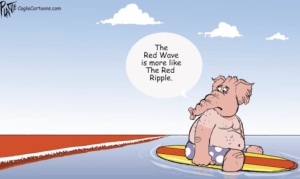 So, since the Republicans, who only lie and would not know the truth if it bit them on the ass (which it frequently does in fact do) said it, and the New York Times verified it in breathless scary headline speak, let us assume it is true. There was a red wave on November 8th. Given this, we can now define what a red wave looks like.


 The first one is totally unique to Scrivener in my experience. This is an item under “help” that simply searches all the menus for what you are searching for. Never mind counter arguments to deploying this idea, that any help system will produce the same results mixed up with other results, etc. Especially never mind those arguments from OpenSource world, where the help item on the menu is, traditionally, so useless that I for one don’t even bother using it. It is vestigial. One way to resurrect the idea of OpenSource software even having a useful help option is to simply deploy a search for a term among the menu items in the software itself as a routine feature. This is incredibly useful in complex software where there are perhaps a hundred or so items across all the menu choices. This should be easy to implement. The list of menu items is certainly a set of objects in the software, and probably comes with links to information that could be added to the results. Play around with it, people!
 There are four of five files that I use in Libre Office often enough to want them handy as shortcuts or favorites, but not often enough that they remain near the top of the “Recent Files” list in LibreOffice. A few years ago I tried to convince the LibreOffice community to make the Recent Files item include (as an option?) only files opened in a particular program. The way it works now, recent files opened in Calc (the spreadsheet) are on the list when you are working in the word processor (Writer). Sometimes, when I’m using Calc for a particular project, I may have 10 or 15 files (imported CSV files, various spreadsheets, etc) open over a work session, almost none of which I ever want to see again, but all of which populate the Recent Files menu list. This makes that list less useful, and if the list was separate for each different program (Cals, Writer, Draw, etc.) at least the problem would be partly contained. I don’t remember the reason they gave that this could not be done, but I didn’t buy it at the time. A technical glitch that seemed very solvable.