Haha
Category Archives: Uncategorized
Are there more tornadoes because of global warming?
There are good reasons to believe that global warming leads to more storminess, but the exact nature of that transition is unclear and hard to measure. Part of the reason for this difficulty is that a given type of storm may become more likely under certain conditions caused by climate change, while a different kind of storm may become less likely, with the “storminess” overall increasing but doing so indifferent ways across time. Also, the most severe, and thus possibly the most important, weather events are infrequent so it is difficult to see changes over time with any statistical confidence. I address many of these issues here and here.
Looking at the raw data, it is clear that there are “more tornadoes” over time in the US. Have a look at this graph:

At first glance, his graph makes it look like there are a lot more tornadoes, but there is a strong effect of observer error; earlier tornadoes were simply missed much of the time, so the big increase you see here, while it may reflect an underlying increase in number of tornadoes, is not reliable and cant’ be taken as evidence. However the later years shown here, from 1950-something to the 1990s, seems to show an increase that could be taken as meaningfull
However, when people speak of tornadoes they often show this graph as evidence that there are not more of them over time:

Looking only at this graph it looks like the number of tornadoes per year in the US is pretty variable but not increasing, as one would expect if global warming was causing more of them.
There is a problem with this graph, however. Actually, a couple of problems (other than those pointed out here). The main problem is that the most frequent tornadoes are left off this graph. If we look at F0 grade tornadoes, not included here, we see that they have actually increased in frequency over time. If we include ALL tornadoes, and not just the kinds that don’t seem to increase in frequency over time, we get this graph:

Compare the scales of the last two graphs. It turns out that the number of tornadoes at the smaller end of the scale goes up quite a bit. It might be hard to see. The upper graph goes up to 900, the lower graph goes up to 1900. So, if we add all the data instead of just select data, we get many hundreds more tornadoes per year.
The proportion of tornadoes that are F0 increases over time as shown here:

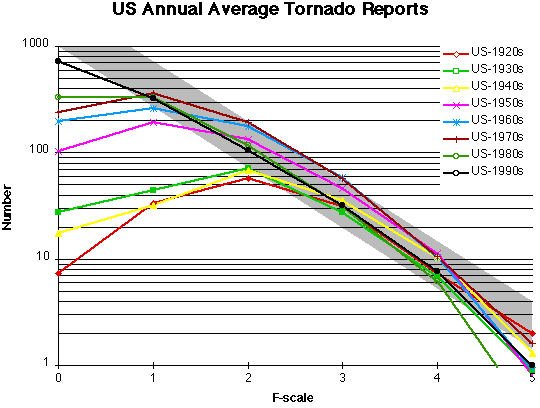
… and the overall distribution of tornadoes by strength changes over time as shown in this very cool graph: 
As I point out here, one of the contributing factors to variation over time in tornado frequency is the fact that we have somewhat arbitrary boundaries in which we measure them. For instance, the US-Canada border provides an arbitrary line across our data set. By not counting all North American tornadoes the same way, we may be adding unnecessary variability to the data. To demonstrate this, have a look at this graph showing tornado frequency per year in France and Germany, two countries that are right next to each other:

This shows a few things. For one thing, they don’t have too many tornadoes in that part of the world. For another thing, there is an increase in overall frequency over time, and this is not because of lack of reporting. The reporting problem in the US is partly because the western and central states were relatively empty in the old days, and also more technology was available for spotting tornadoes later. But the European and US data have the same shape over a similar time span, but France and Germany do not have the missing observations owing to vast unoccupied (sort of) territories.
But the main thing I want to demonstrate with this graph is the fact that dividing a largish area of land up into arbitrary units can cause your data go go all flooey. Increased variability in data owing to partitioning is a well known phenomenon and this is what it looks like.
Another part of the problem is that the largest storms, which may be the most important ones, have a great deal of variation in their occurrence. Compare any of the graphs above of all tornadoes or all excluding the F0 tornadoes of this graph of just the largest storms:

Not only is there a lot of variation in numbers of tornadoes at the larger end of the scale, but I suspect there is a lot of variability among the tornadoes in each class in terms of overall energy represented. An F4 tornado that lasts five minutes compared to an F4 tornado that lasts 20 minutes are hugely different, but this is not reflected in this sort of data.
Here is a graph showing the amount of storm damagein adjusted dollars over time in the US (pink) with average temperature (blue). Clearly, the total amount of damage goes up, and probably for a number of reasons including there being more stuff to damage, but also, likely overall increases in storminess including hurricanes, tornadoes, severe thunderstorms, etc.

Here is another graph that shows something similar:

There are many who do not want to link increases in severe weather to global warming. They are probably wrong. Global warming seems to increase severe weather overall. The best way to deny this is to cherry pick the data by ignoring variability across space, leaving out entire categories of storms, or focusing on just some kinds of storms. I suspect the size and severity of tornadoes at the larger end is increasing now, but did not start increasing until recently; time will tell if this is right. But overall tornadoes are so variable across time and space that they are not a reliable canary, as it were. But overall storminess seems to be on the increase, in accordance with expectations from the basis physics of climate, under warming conditions.
Science 4 People Cover

Hat tip:
cc @teh_skeptic RT @alicebell: Love this cover of 70s Science for PEOPLE. Edition published by women’s collective twitter.com/alicebell/stat…
— marieclaire shanahan (@mcshanahan) May 14, 2013
How To Get Rid Of Fur Balls: Caturday Book Recommendation
Crafting with Cat Hair: Cute Handicrafts to Make with Your Cat



Got fur balls?
Are your favorite sweaters covered with cat hair? Do you love to make quirky and one-of-a-kind crafting projects? If so, then it’s time to throw away your lint roller and curl up with your kitty! Crafting with Cat Hair shows readers how to transform stray clumps of fur into soft and adorable handicrafts. From kitty tote bags and finger puppets to fluffy cat toys, picture frames, and more, these projects are cat-friendly, eco-friendly, and require no special equipment or training. You can make most of these projects in under an hour—with a little help, of course, from your feline friends!
They totally think we’re not smart …. (solar energy)
Hahaha
Ha.
This is about solar energy being repressed by energy interests in Arizona.
Skeptically Speaking on Star Stuff
You might be interested in the latest Skeptically Speaking podcast:
This week, Skeptically Speaking looks to the stars that light up the night sky, and fuse hydrogen and helium into the elements that make life possible. Science writer Jennifer Ouellette examines the possible evidence of ancient supernovae in bacterial fossils. Astrophysicist Ethan Siegel explains the controversy surrounding the so-called black hole firewall paradox. And astronomer Pamela Gay of CosmoQuest discusses the impact of U.S. sequester budget cuts on her research and outreach.
Creationism du jour
Genie Scott of the NCSE gives a talk on Creationism.
Executive director Genie Scott talks about the history of creationist legislation, including bills that allow teachers to “critically analyze” evolution or present the “full range of scientific views of origins”. Strategies, tactics, and more. When: 12/1/2012. Where: Eschaton 2012, Ottawa. Video courtesy of www.youtube.com/user/AtheismTV
(Don’t be put off by the audio problems in the beginning it gets fixed.)
Look at this tweet by Obama

Ninety-seven percent of scientists agree: #climate change is real, man-made and dangerous. Read more: OFA.BO/gJsdFp
— Barack Obama (@BarackObama) May 16, 2013
Should you drink tap water or bottled water?
This is the time of year, spring, when a lot of people switch to drinking bottled water instead of tap water. They do this because in their particular area the tap water seems to “go bad” … usually it is a mild smell or a slightly icky taste. This makes people fear their tap water, so they go to the store and buy bottled water. What has happened in many cases is that the local municipal water supply has done everything it can reasonably do to clean up and make nice the water that comes out of your tap, but there is this slight taste or smell because in the spring, that is what water does in many of our sources, including wells, rivers, and reservoirs. It depends on where you live, and it probably depends on the year as well.
Your municipal water is safe. Tap water always has “stuff” in it that is not H2O, but in the spring, some of that stuff is a bit more detectable than at other times of the year.
People are making two mistakes. 1) Not drinking the tap water because they think it is bad for them. It may be unpleasant, and that may be a reason to not drink it, but it is not bad for you. And, 2) quitting tap water forever, switching to bottled water because they think their water has gone bad forever. Or they just get used to the bottled water and stick with it.
Peter Gleick has a lot of information about Bottled Water, some of which is on his new blog. The total amount of Carbon you are releasing into the atmosphere by drinking a liter of bottled water is something like an order of magnitude greater than for tap water, for example. You just shouldn’t be using bottled water if you have a run of the mill municipal water supply.
Speaking of water, Skeptically Speaking just did a show on the topic:
Drinking Water
This week, we’re looking at the science and the history of the water that makes life and society possible. We’ll speak to law and environment professor James Salzman, about his book Drinking Water: A History. And we’re joined by Juewen Liu, chemistry professor at the University of Waterloo, to talk about his work using DNA to detect water-borne impurities that could make water unsafe.
Click here to get the podcast.
Photo Credit: Lightsurgery via Compfight cc
Other posts of interest:
- How to get rid of spiders in your house
- Why is your poop green?
- How many cells are there in the human body?
- Is there really a plot hole in Harry Potter Goblet of Fire?
- How long is a human generation?
- Is blog ever really blue?
- How to not get caught plagiarizing
- The origin of the domestic chicken
- What are the three necessary and sufficient conditions of Natural Selection?
- How do I get rid of foot fungus?
- Which is better, Tap Water or Bottled Water?
- Has Global Warming stopped?
Also of interest: In Search of Sungudogo: A novel of adventure and mystery, which is also an alternative history of the Skeptics Movement.
Want to boycott stuff? There’s an app for that.
Vote with your wallet. Tired of the Koch Brothers ruining everything for everybody? Prefer to buy products from companies that contribute to Sandy relief? Do you just want to know which major megacorporation produced the item you are considering putting in your shopping cart?
Wouldn’t it be nice to have an app that allowed you to scan the product’s bar codes and quickly determine which evile empire you are supporting, or avoiding supporting, with your purchasing decision. Well, there is, and it is called Buycott. Click here to see iOS version
From the app developers:
How Buycott works
-Join a campaign to help a cause you care about and commit to actively supporting the companies on your side of the issue, while avoiding those that oppose your position.
-Scan product barcodes and Buycott will find out what company owns that product (and who owns that company, ad infinitum).
-Using this information, Buycott will determine whether you have joined a campaign that includes the product’s owners.
Features
– Lookup the ownership structure of any product and trace it all the way back to its parent company with our interactive family tree diagram.
– Offers a variety of contact data for companies and brands, so you can easily inform them of your decision to support or avoid their products.
– Scans all major retail barcodes (UPC-A, UPC-E, EAN8, EAN13, etc).
– Create your own campaign from buycott.com
Once installed you have to sigh up. I chose the “Log In with Facebook” option and then was asked if Buycott could post to my friend’s walls. I said no. The signup failed. So, right there, somebody needs to sit these kids down (the ones who made the app) and explain to them the meaning of Irony.
So then I signed up with the manual sign up and I got an “error creating account” error. No explanation.
So, I’d like to try this app out for you but it’s broke, so I can’t. But I also know that word of this app just went around the internet a few minutes ago, so their server is probably getting hammered. I’ll try again in a day or two and let you know how it goes. If you try it and have any info to report, please put it in the comments.
This would be good if it works. But first, it has to …. well, work.
UPDATE:
I was able to join this evening, but the join up process took a long time, presumably because of the developer’s server still being overwhelmed (or attacked by nefarious forces, perhaps?). Then things were still a little glitchy. When I went into the app I was told that I needed to join before I could use it, but Ignored that and signed in using the info I had given it when I had joined earlier, and then I was told that I’d have to Join, the, I was allowed to use the app as though I had joined.
This all happened because the app seems to reset to some prior level when my iPhone does its partial sleep power down thing it does after several seconds of no activity, and everything the app does is so slow that this happens all the time.

I then checked All Free an Clear laundry soap, a container of little tomatoes, and a container of Laqwry’s seasoned salt. The first two returned errors, the third returned data on the product that was accurate and information about the company. I was told that there were “no campaign conflicts.”
Lawry Salt is OK!
So the bottom line is that the app works but there are glitches that hopefully will be ironed out.
The amount of time it takes to get the information back from the scan is fairly long … tens of seconds … but that is probably because their server is still working too hard.
Who is the richest person in the world?
This came up the other day, so I figured I’d note the answer(s) down and share it with you so we don’t have to look this up in the internet again until 2013 is over. The, I think they get new richest people. Most of these answers come from Forbes, which appears to be in charge of knowing these things. Or even, perhaps, determining these things!
Who is the richest person in the world?
The richest person in the world is Carlos Slim Helu and his family, with a net wort of 73 billion dollars. He’s in Mexico, and in the telecom business. But since this includes “his family” we may want to note that the number two perso on the list is Bill Gates, of Microsoft fame, who is worth 67 billion dollars. I will note that the fifth richest person in the world is a guy who is the brother of someone I know. Fat lot of good that does me, I know, but still.
Who is the richest woman in the world?
We have to go down the list pretty far to find the richest woman in the world. Liliane Bettencourt and family are listed by forbes as the 9th richest “person” in the world, she’s in france and is the “L’Oreal Bettencourt. Christy Walton and Family are at number 11. We have to go down to number 16 before we find a woman who is not “and family” rich, and that’s Alice Walton of Wal-Mart. Note that CHristy Walton and Family and Alice Walton (sans family) are both Wal-Mart. We can add Jim Walton and S. Robson Walton to that list and the Wal-Mart family, extended, appears to be worth a total of 107.3 billion dollars. Ironically, that makes the value of at least this part of the Wal-Mart family worth about the same as Bangladesh. If they were a country they’d be about 57th.
Who is the richest person in America?
The richest person in America is obviously Bill Gates (see above)
Who is the richest woman in America?
The richest woman in America is the Wal-Mart lady mentioned above.
The average number of offspring (we can use this as an estimate of fertility rate) among the top richest people is 3.0. The fertility rate of the average American at the moment is about 2.03.
A lot of people assume, because they’ve been told this and accepted it uncritically, or for other reasons, that the poor and dark skinned have more babies than the rich and the light skinned. Apparently not.
Minnesota Voters (sometimes)

Women abusing and killing men
The news for Minnesota today, and over the last few days, is unbelievable. Here in the twin cities, the body of a guy who police think was killed by his girlfriend was found in a swamp. She’s in prison serving time for a different crime but now the investigation may move towards charging her with homicide. Just earlier this week the body of a man who authorities say may have been killed by his wife was found in the Mississippi river. Originally police had been searching a lake near Saint Paul but it turns out his body had been dumped elsewhere, presumably by his homicidal wife. And this weekend there will be a major volunteer effort to expand the search for a young man in Eden Prairie, and I’ll bet we’re going to find out that he was killed by his girlfriend too. And of course, a few weeks ago we heard about the North Saint Paul 17 year old boy who’s body was “found” by his “girlfriend,” but then it turns out that he was killed by that very same girlfriend, who eventually admitted it.
And this all comes at the same time as news of that horrific thing in Cleveland, where three young men were kidnapped nearly 10 years ago by some woman who was a sexual predator, who then raped them again and again and …
…. hey, wait a minute …
And in today’s news….
We have a big race coming up in the Twin Cities. The local news just reported that “in light of the events that happened in Boston, runners are encouraged to pack light when they go to the race.”
The death toll in Bangladesh has gone to 1,000 as one person was pulled out alive after 17 days.
Today, the atmospheric concentration of CO2, which should be about 280 ppm, reached 400 ppm. It will fluctuate a bit below and above 400 over the next couple of years, then stay above 400 for the long term, certainly over the life time of any infants born today. This is all going to look pretty silly when sea levels rise 9 feet. Which will just be the beginning.
As I write this hipsters are being interviewed about the shooting that just happened in South Minneapolis. They were hyped.
The news reporters can no conceive of an address in the 2700s would be near the corner of 28th street. This is what happens when we let suburbanites handle our news reports. Also, yes, it matters if it is “N” or “S” because almost every avenue in the city has a North and a South part.
That is all for now.
The Story of Genie
As you know, Genie Scott of the NCSE will retire this year. Here is her story.